Best Open Source LLMs to Replace Sonnet 4.5 or Opus 4.6: Affordable AI Coding Alternatives 2026
Discover the top 5 open source language models that can replace Claude Sonnet 4.5 or Opus 4.6 for coding tasks at a fraction of the cost: GLM-5, Kimi K2.5, Qwen-Max, MiniMax M2.5, and Devstral 2.
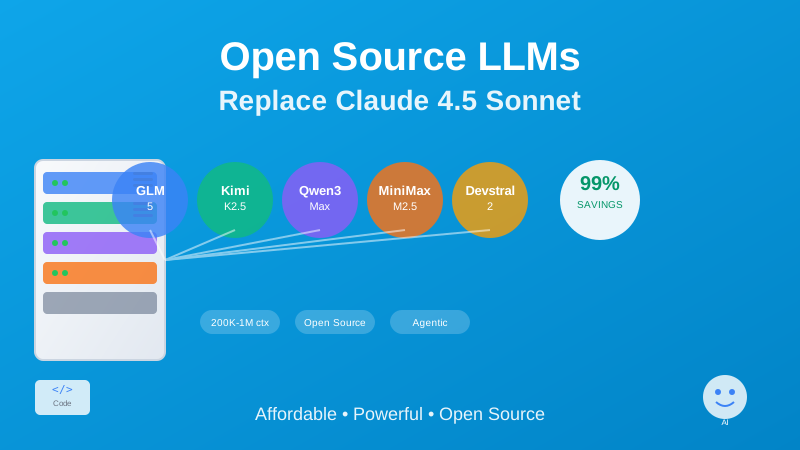
Claude Sonnet 4.5 or Opus 4.6 works well for coding, but it’s expensive. Plenty of developers are looking for alternatives that don’t cost as much. The open source AI space has grown a lot since 2025, and now there are models that can do what Claude does for much less money.
This guide covers five open source models that can replace Claude Sonnet 4.5 or Opus 4.6 for coding: GLM-5, Kimi K2.5, Qwen-Max, MiniMax M2.5, and Devstral 2. These models handle reasoning, code generation, and agent tasks well, and they cost significantly less than Claude.
Cost Comparison Overview
While Claude Sonnet 4.5 costs $3-15 per million tokens, these open source alternatives range from $0.15 to $1.20 per million input tokens, offering savings of up to 95%.
Why Consider Open Source LLM Alternatives?
Open source models have improved a lot and can compete with proprietary options. Here’s why they’re worth considering:
- Cost Efficiency: API costs are much lower than proprietary models
- Transparency: Open source code lets you understand and modify the model
- Performance Parity: Many open source models match or beat Claude Sonnet 4.5 on various tasks
- Flexibility: You can self-host or use various API providers
- Community Support: Active development teams keep improving the models
Key Performance Areas to Consider
When evaluating LLM alternatives, several factors matter:
- Coding Capabilities: How well the model generates, debugs, and explains code
- Reasoning Performance: How well it handles complex problems and logical thinking
- Context Length: How much information the model can process at once
- Agentic Tasks: Tool usage, function calling, and multi-step task execution
- Cost-Performance Ratio: How much value you get per dollar spent
What’s New with Claude Sonnet 4.5?
Before looking at alternatives, it helps to understand what Claude Sonnet 4.5 does well. Released in early 2025, Claude Sonnet 4.5 is Anthropic’s latest model:
- Best Coding Model: Scores 77.2% on SWE-bench Verified and stays focused on complex tasks for 30+ hours
- Computer Use Leader: 61.4% on OSWorld benchmark, up from 42.2% with Sonnet 4
- Enhanced Reasoning: Better reasoning and math capabilities
- Improved Alignment: Less sycophantic and deceptive behavior than previous models
- Premium Pricing: $3 per million input tokens, $15 per million output tokens
Claude Sonnet 4.5 and Opus 4.6 is powerful, but the price makes it hard to justify for many developers and businesses. Open source alternatives offer similar performance for much less money.
1. GLM-5: Agentic engineering with record-low hallucinations
GLM-5 is Z.AI’s new flagship, and the jump from GLM-4.7 is significant. It went from 357B to 744B total parameters while keeping MoE efficiency at 40B active. Two things stand out: DeepSeek Sparse Attention for handling long contexts without blowing up inference costs, and a new RL infrastructure called “slime” that brought hallucination rates down to near zero. In coding benchmarks, it’s approaching Claude Opus 4.5 territory.
Technical Specifications
| Feature | GLM-5 |
|---|---|
| Total Parameters | 744B (MoE) |
| Active Parameters | 40B |
| Context Length | 200K tokens |
| Architecture | MoE with Sparse Attention |
| Input Cost | $0.80/M tokens |
| Output Cost | $2.56/M tokens |
| License | MIT |
| Release Date | February 2026 |
Key Strengths
- Agentic engineering: Handles complex system engineering and long-horizon agent tasks with multi-step planning
- 95.8% SWE-bench Verified: The highest coding score among open source models right now
- Near-zero hallucinations: Scores -1 on AA-Omniscience Index, up from GLM-4.7’s -36
- Strong reasoning: 92.7% on AIME 2026 and 86.0% on GPQA-Diamond
- Sparse Attention: DeepSeek Sparse Attention keeps deployment costs down even with 200K context
- “Slime” RL infrastructure: Async RL with Active Partial Rollouts (APRIL) for post-training refinement
Performance Highlights
Here’s where GLM-5 lands on the benchmarks that matter:
- Coding: 95.8% on SWE-bench Verified. It’s also the first open model to break 50 on the Artificial Analysis Intelligence Index v4.0
- Reasoning/math: 93.6% accuracy overall, 92.7% on AIME 2026, 86.0% on GPQA-Diamond
- Agentic work: ELO 1,412 on GDPval-AA (only Claude Opus 4.6 and GPT-5.2 score higher). #1 on Vending Bench 2
- Reliability: 97% success rate across benchmarks, with the lowest hallucination rate of any open model tested
GLM Coding Plans
For coding, Z.AI offers GLM Coding Plans with pricing and features for developers.
Best Use Cases
GLM-5 works well for:
- Long-running agent tasks: Multi-step planning across complex systems
- Production coding: Full-stack development where you need something close to Claude Opus 4.5
- Enterprise work: MIT license and low hallucination rate matter when mistakes are expensive
- Document generation: Can produce business documents in PDF, Word, and Excel formats
- Tool-heavy workflows: Reasoning plus tool integration and search
2. Kimi K2.5: Multimodal coding with agent swarms
Kimi K2.5 is Moonshot AI’s strongest open-source model. It’s natively multimodal (pretrained on ~15T mixed visual and text tokens), which means it can actually look at images and videos, not just text. The standout feature is its agent swarm: it can spin up to 100 sub-agents working in parallel.
Technical Specifications
| Feature | Specification |
|---|---|
| Total Parameters | 1 Trillion |
| Active Parameters | 32 Billion |
| Context Length | 256K tokens |
| Architecture | Mixture-of-Experts (MoE) |
| Input Cost | $0.60/M tokens |
| Output Cost | $3.00/M tokens |
| Release Date | January 2026 |
| Agent Swarm | Up to 100 sub-agents |
Outstanding Features
- Agent swarm: Self-directs up to 100 sub-agents with up to 1,500 coordinated tool calls for parallel workflows
- Coding from visuals: Generates code from images, videos, and visual debugging natively
- 256K context: Enough to fit a full codebase and long-form outputs
- 76.8% SWE-bench Verified: Solid real-world software engineering performance
- Claude Code compatible: Works with Claude Code, Cline, and other agent frameworks
- $0.60/M input tokens: Good price for what you get
- Kimi Code CLI: Open-source CLI agent that takes images and videos as inputs
Benchmark results
Kimi K2.5 scores well across coding and vision tasks:
- Coding: 76.8% on SWE-bench Verified, 73.0% on SWE-bench Multilingual, 85.0% on LiveCodeBench v6
- Vision: 78.5% on MMMU-Pro, 84.2% on MathVision, 88.8% on OmniDocBench 1.5
- Agentic: 78.4% on BrowseComp with agent swarm, 50.2% on HLE-Full with tools
- Context: 256K tokens handles medium-sized repositories in one session
- Video: 86.6% on VideoMMMU, 79.8% on LongVideoBench
Best value for multimodal
Kimi K2.5 is the only model here with native vision support, plus the agent swarm for parallel execution, all at $0.60 per million input tokens.
When to use it
- Visual coding: Generate code from UI mockups, screenshots, or video demos
- Parallel agent workflows: Agent swarm cuts runtime by up to 4.5x
- Large codebases: 256K context fits entire repositories
- Frontend work: Responsive interfaces with charts and visual elements
- Document processing: Handles 10,000-word papers or 100-page documents with annotations
- Tight budgets: You get a lot of capability per dollar
- Long coding sessions: Keeps conversation history across extended workflows
3. Qwen-Max: Qwen3’s biggest model
Qwen-Max is the top model in the Qwen3 series. It handles coding, reasoning, and general tasks with a 256K context window and uses an OpenAI-compatible API, so integration is straightforward.
Technical Specifications
| Feature | Specification |
|---|---|
| Model Family | Qwen3 |
| Context Length | 256K tokens |
| Architecture | Advanced Transformer |
| Input Cost | $1.20/M tokens |
| Output Cost | $6.00/M tokens |
| Release Date | September 2025 |
| API Compatibility | OpenAI format |
What it offers
- Qwen3’s top model: The most capable in the Qwen lineup
- 256K context: Fits large codebases in a single session
- Solid benchmarks: Good scores on MMLU, MMMU, and HellaSwag
- Versatile: Coding, reasoning, and general tasks in one model
- OpenAI-compatible API: Swap your API key and base URL, done
- Stable in production: Reliable for business workloads
Benchmark performance
Qwen-Max holds its own across multiple evaluations:
- General: Strong scores on MMLU, MMMU, and HellaSwag
- Coding: Competitive on coding-specific benchmarks
- Long context: Handles large codebases with 256K tokens
- Production use: Consistent and reliable in real deployments
- Multi-task: Performs well across different task types
Development Ecosystem
API Compatibility
Qwen-Max uses an OpenAI-compatible API, so you can integrate it by updating the API key and base URL.
When to use it
- Enterprise work: Production-grade AI for business-critical tasks
- Full-stack development: Multiple languages and frameworks
- Repository-wide operations: 256K context for large-scale analysis
- Mixed workloads: Coding, reasoning, and general queries in one model
- Existing OpenAI setups: Drop-in replacement with API key swap
4. MiniMax M2.5: SOTA coding at a fraction of the cost
MiniMax M2.5 is the latest in the M2 series, and the jump from M2.1 is substantial. MiniMax trained it with reinforcement learning across more than 200,000 real-world environments, pushing SWE-bench Verified to 80.2%, which beats Claude Opus 4.6 on multiple scaffolds. It ships in two speed tiers: M2.5 at 50 tokens/second and M2.5-Lightning at 100 tokens/second, both priced low enough to run agents continuously without worrying about cost.
Technical Specifications
| Feature | MiniMax M2.5 |
|---|---|
| Architecture | Mixture-of-Experts (MoE) |
| Context Length | 200K tokens |
| M2.5 Input Cost | $0.15/M tokens (50 TPS) |
| M2.5 Output Cost | $1.20/M tokens (50 TPS) |
| Lightning Input Cost | $0.30/M tokens (100 TPS) |
| Lightning Output Cost | $2.40/M tokens (100 TPS) |
| Release Date | February 12, 2026 |
What it does well
- 80.2% SWE-bench Verified: Beats Claude Opus 4.6 on the Droid scaffold (79.7 vs 78.9) and OpenCode (76.1 vs 75.9)
- Spec-writing approach: Plans features, structure, and UI design before writing code, like an experienced software architect
- 10+ programming languages: Go, C, C++, TypeScript, Rust, Kotlin, Python, Java, JavaScript, PHP, Lua, Dart, Ruby
- 37% faster than M2.1: Completes SWE-bench tasks in 22.8 minutes on average, matching Opus 4.6 speed
- Beyond bug fixes: Goes from 0-to-1 system design through environment setup, feature iteration, code review, and testing
- Two speed tiers: M2.5 at 50 TPS and Lightning at 100 TPS (twice as fast as other frontier models)
- Office automation: Word formatting, PowerPoint editing, Excel financial modeling with built-in Office Skills
- Agent framework support: Works with Claude Code, Droid, Cline, Roo Code, OpenCode
Benchmark results
- SWE-bench Verified: 80.2% (Droid: 79.7 vs Opus 4.6’s 78.9; OpenCode: 76.1 vs 75.9)
- Multi-SWE-Bench: 51.3%, particularly good at non-Python languages
- BrowseComp: 76.3% with context management, using ~20% fewer search rounds than M2.1
- VIBE Pro: Matches Claude Opus 4.5 on the upgraded benchmark across Web, Android, iOS, and Windows
- Speed: 22.8 minutes average per SWE-bench task, down from 31.3 minutes on M2.1
- Cost per task: About 10% of what Claude Opus 4.6 charges for the same work
Cheapest frontier model
Running M2.5 continuously for an hour at 100 tokens/second costs $1. At 50 TPS, it drops to $0.30/hour. Four instances running 24/7 for a year would cost about $10,000.
Best Use Cases
MiniMax M2.5 works well for:
- Always-on coding agents: Cheap enough to run continuously without budget anxiety
- Multi-Language Projects: Trained on 10+ languages across 200,000+ real-world environments
- Full-stack work: System design, APIs, business logic, databases, and frontend across Web, Android, iOS, and Windows
- Office automation: Financial modeling in Excel, report generation in Word, presentations in PowerPoint
- Interactive Coding Assistants: Lightning variant’s 100 TPS makes IDE integration responsive
- Self-Hosting: Open source weights for on-premise deployment with vLLM or SGLang
5. Devstral 2: Dense architecture for repository-scale work
Devstral 2 takes a different approach. While the other models here use MoE, Devstral 2 is a 123B dense transformer. That means all parameters are active on every inference, which gives it better coherence on whole-repository tasks. It ships with Mistral Vibe, a CLI agent for terminal-based automation.
Technical Specifications
| Feature | Devstral 2 |
|---|---|
| Total Parameters | 123B (Dense) |
| Active Parameters | 123B |
| Context Length | 256K tokens |
| Architecture | Dense Transformer |
| Input Cost | $0.40/M tokens |
| Output Cost | $2.00/M tokens |
| Release Date | December 2025 |
What it does well
- Dense architecture: All 123B parameters active, so reasoning stays coherent across large repos
- Built for agents: Tuned for Vibe CLI to handle multi-file edits, git operations, and test loops
- Devstral Small 2: A 24B companion model that runs on consumer hardware (Apache 2.0 license)
- 72.2% SWE-bench Verified: Beats many larger MoE models
- Mistral Vibe CLI: Open-source terminal assistant for autonomous coding
Benchmark results
- SWE-bench Verified: 72.2%, at the frontier for open-weight models
- Human evaluation: Preferred over DeepSeek V3.2 in Cline-based coding tasks (42.8% win rate)
- Local model: Devstral Small 2 (24B) hits 68.0% SWE-bench, strong for a model you can run locally
- Cost: Up to 7x cheaper than Claude Sonnet on real-world tasks
Run it locally
Devstral Small 2 (24B) runs on high-end consumer GPUs, so you can have a fully local coding agent without sending any code to external servers.
Best Use Cases
Devstral 2 works well for:
- Agentic Workflows: Using Mistral Vibe CLI for autonomous terminal-based coding
- Repository Refactoring: Dense architecture provides better coherence for large-scale changes
- Local Development: Devstral Small 2 lets you use powerful coding assistance on local hardware
- Secure Environments: Open weights and local deployment options for strict data privacy
Side-by-side comparison
Here’s how all five stack up:
Performance Comparison Table
| Benchmark | GLM-5 | Kimi K2.5 | Qwen-Max | MiniMax M2.5 | Devstral 2 | Claude Sonnet 4.5 |
|---|---|---|---|---|---|---|
| SWE-bench Verified | 95.8% | 76.8% | Strong | 80.2% | 72.2% | 77.2% |
| LiveCodeBench v6 | Strong | 85.0% | Strong | Strong | Strong | 84.5% |
| MMMU-Pro | — | 78.5% | — | — | — | 74.0% |
| Context Window | 200K | 256K | 256K | 200K | 256K | 200K |
| Agent Swarm | No | Yes | No | No | No | No |
| Vision Support | No | Yes | No | No | No | No |
| Cost per 1M Input Tokens | $0.80 | $0.60 | $1.20 | $0.15 | $0.40 | $3.00 |
| Cost per 1M Output Tokens | $2.56 | $3.00 | $6.00 | $1.20 | $2.00 | $15.00 |
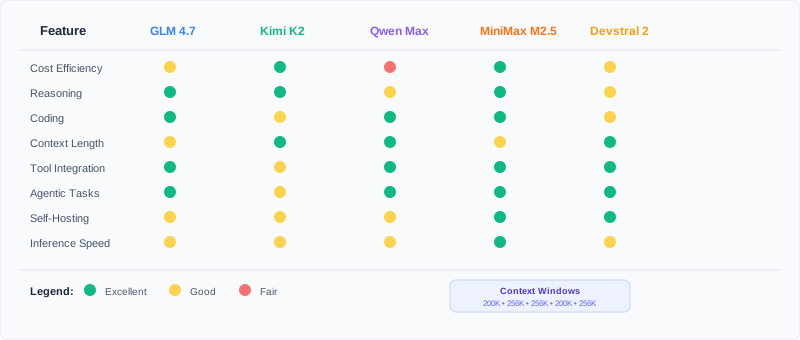
Feature Comparison Matrix
Getting started
Step 1: Choose Your Access Method
Each model offers multiple access options:
- OpenRouter: Unified API access to all models with competitive pricing
- Direct API Access: Provider-specific endpoints for optimized performance
- Self-Hosting: Deploy models on your own infrastructure for maximum control
- Development Tools: Integration with coding assistants and IDEs
Step 2: Set Up Your Environment
For OpenRouter access (recommended for beginners):
# Install OpenAI SDK
pip install openai

# Set environment variables
export OPENROUTER_API_KEY="your_api_key_here"
export OPENROUTER_BASE_URL="https://openrouter.ai/api/v1"
Step 3: Basic Implementation Example
import openai

client = openai.OpenAI(
    base_url="https://openrouter.ai/api/v1",
    api_key="your_openrouter_api_key"
)

# Use GLM-5 for agentic tasks
response = client.chat.completions.create(
    model="z-ai/glm-5",
    messages=[
        {"role": "system", "content": "You are a helpful coding assistant."},
        {"role": "user", "content": "Create a Python web scraper for product prices"}
    ]
)

print(response.choices[0].message.content)
Step 4: Optimize for Your Use Case
Context Length Considerations
Kimi K2.5, Qwen-Max, and Devstral 2 lead with 256K tokens, while GLM-5 and MiniMax M2.5 support 200K tokens—all excellent for complex coding tasks.
Cost breakdown
Here’s what you’d actually pay at 10M tokens/month:
Monthly Cost Comparison (Based on 10M tokens usage)
| Model | Input Cost | Output Cost | Total Monthly Cost | Savings vs Claude Sonnet 4.5 |
|---|---|---|---|---|
| Claude Sonnet 4.5 | $30.00 | $150.00 | $180.00 | Baseline |
| GLM-5 | $8.00 | $25.60 | $33.60 | 81.3% savings |
| Kimi K2.5 | $6.00 | $30.00 | $36.00 | 80.0% savings |
| Qwen-Max | $12.00 | $60.00 | $72.00 | 60.0% savings |
| MiniMax M2.5 | $1.50 | $12.00 | $13.50 | 92.5% savings |
| Devstral 2 | $4.00 | $20.00 | $24.00 | 86.7% savings |
What the savings mean in practice
- More experimentation: Lower costs let you test and iterate more freely
- Team-wide access: Run AI assistance for your whole team, not just a few developers
- Broader integration: Use AI in more parts of your application
- Faster shipping: More AI-assisted development cycles without budget anxiety
Tips and common mistakes
What works
- Match model to task: Use cheaper models for simple tasks, bigger ones for complex reasoning
- Manage context carefully: Longer context costs more tokens, so be deliberate
- Invest in prompts: Each model responds differently to prompt style
- Batch requests: Combine calls to reduce overhead
- Monitor outputs: Track quality in your specific domain
What to avoid
- Over-Engineering: Don’t use the most expensive model for simple tasks
- Inadequate Testing: Always validate model outputs in your specific domain
- Context Overflow: Monitor token usage to avoid unexpected costs
- Single Model Dependency: Consider using different models for different tasks
What’s coming next for open source LLMs
A few trends worth watching:
- Domain-specific models: More specialized options like Qwen3 Coder
- Better efficiency: More performance per parameter and per dollar
- Tighter tool integration: Better compatibility with IDEs and coding workflows
- Multimodal by default: Vision and audio becoming standard, not optional
- Faster inference: Latency dropping enough for real-time use
Which one should you pick?
It depends on what matters most to you:
GLM-5 if you need:
- Top coding scores: 95.8% SWE-bench Verified, highest among open source
- Agentic engineering: Long-horizon multi-step planning
- Low hallucinations: Record-low rate, good for enterprise
- Strong reasoning: 92.7% on AIME 2026, 86.0% on GPQA-Diamond
- MIT license: Full commercial and self-hosting freedom
Kimi K2.5 if you want:
- Vision support: The only model here that can read images and video
- Agent swarms: Parallel execution with up to 100 sub-agents
- 256K context: Fits entire repositories
- Claude Code compatibility: Works with Claude Code and Kimi Code
- Good price: $0.60/M input tokens for all of the above
Qwen-Max if you care about:
- All-around capability: Qwen3’s top model, solid across the board
- Production reliability: Stable for business-critical workloads
- OpenAI compatibility: Drop-in replacement for existing setups
- 256K context: Large-scale codebase operations
MiniMax M2.5 if you want:
- Frontier coding scores: 80.2% SWE-bench Verified, beating Claude Opus 4.6
- Always-on agents: $1/hour at 100 TPS, $0.30/hour at 50 TPS
- End-to-end coding: System design through code review and testing, not just bug fixes
- Multi-language coding: 10+ languages across 200,000+ real-world environments
- Office automation: Word, PowerPoint, Excel with built-in Office Skills
- Fast inference: Lightning variant runs at 100 tokens/second
Devstral 2 if you need:
- Local deployment: 24B small model runs on consumer GPUs
- Dense reasoning: All parameters active for coherent whole-repo work
- Terminal agent: Native Mistral Vibe CLI integration
- Data privacy: Open weights, run everything locally
Any of these five models will save you money compared to Claude Sonnet 4.5. GLM-5 leads on coding benchmarks, Kimi K2.5 is the only one with vision, MiniMax M2.5 is the cheapest with frontier-level scores, Qwen-Max is the most versatile, and Devstral 2 is the best for local/private use. Pick the one that fits your workflow and budget.
Ready to get started?
All five models are available through their respective providers and OpenRouter. Pick one, swap your API key, and start coding.