Google ADK OpenRouter: Use Any Model in Your AI Agent
Use any OpenRouter model in your Google ADK agent with LiteLLM. Google ADK OpenRouter 2026 guide: setup code, pricing, security fixes, troubleshooting tips.

19 min read
Google ADK Tutorials
Part 2 of 3
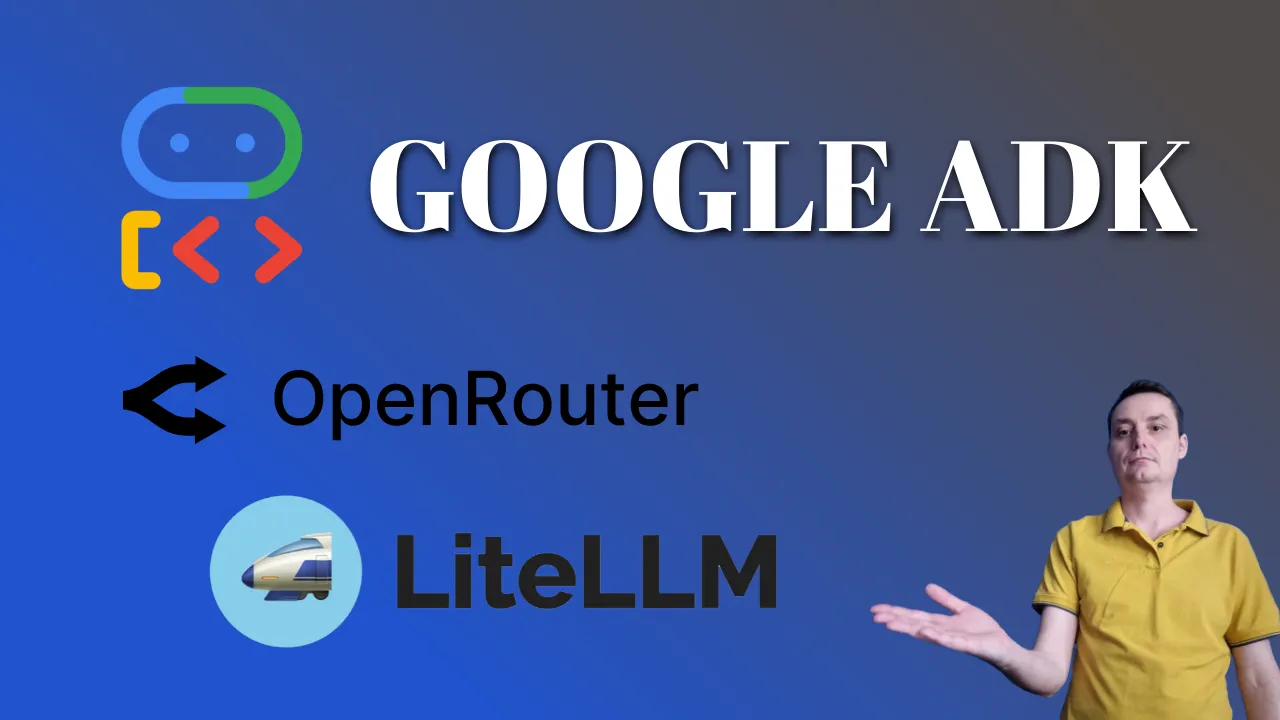
The Google ADK OpenRouter path is a one-line change: wrap the model in LiteLlm, leave everything else alone. If you followed build your first ADK agent with Tavily search and memory and ended up on Gemini, you can point the same agent at any of the 462 OpenRouter models by rewriting the model= parameter. Tools, session memory, and the Runner stay untouched.
The Google Agent Development Kit (ADK) has moved since that first article. Python hit v1.0.0 GA in May 2025, v2.0.0 GA in May 2026 with multi-agent workflow and graph support, and v2.12.0 on 2026-10-13. There are now TypeScript, Go, Java, and Kotlin flavors alongside Python, and the repo sits at around 21.9k GitHub stars. What has not changed is the model layer: Google models take a plain model string, everything else goes through wrapper classes like LiteLlm, which talks to LiteLLM and its 100+ providers. The swap pattern below works the same on 2.x.
The guide covers a security pin to apply before installing anything, how the OpenRouter catalog and its :free/:batch variants price out, the env-only config, verify steps that catch dead model IDs before your agent does, and the failure modes worth knowing. One API key, 462 models, pay-per-token from about $0.02 per 1M input tokens.
LiteLLM security: pin litellm>=1.84 before you install
On March 24, 2026, unauthorized code was found in LiteLLM v1.82.7 and v1.82.8 published on PyPI. This is a supply-chain incident, not a config mistake. If you installed or upgraded LiteLLM during that window, that code ran on your machine with access to whatever was in your environment. Google’s ADK docs now require litellm>=1.84 and tell affected users to rotate their secrets.
LiteLLM supply-chain incident (March 2026)
If you installed or upgraded LiteLLM around March 24, 2026, rotate every API key that lived on that machine: OpenRouter, Tavily, Google, anything sitting in .env. Then pin litellm>=1.84 (current release as of October 2026: 1.105.1) and commit your lockfile so CI and teammates cannot drift back onto a bad version.
Three habits to adopt before the install steps further down:
- Pin the version. Use
uv add "litellm>=1.84"and never a bareuv add litellm. Unpinned installs will happily grab whatever is newest on PyPI, which is exactly the failure mode of this incident. - Commit
uv.lock. The lockfile is what makes “it worked on my box” reproducible after a bad release lands. - Audit dependencies in CI.
uv auditorpip-auditon every pipeline run is cheap insurance. A failing audit is easier to read at 2am than an unexpectedlitellmversion bump in a diff.
Sources: the ADK LiteLLM integration page and LiteLLM’s March 2026 security update. Treat the pin as standing policy for this stack, not a one-time fix.
What is OpenRouter? One API key, 462 models
OpenRouter is one OpenAI-compatible endpoint, https://openrouter.ai/api/v1, in front of a large model catalog: 462 models in the API as of October 2026. One API key pays for all of them, per token. You do not juggle separate SDKs, billing pages, or provider-specific auth. The count moves, so re-check the live list before you commit an agent to a specific ID.
LiteLLM is the bridge. ADK’s LiteLlm wrapper speaks to LiteLLM, and LiteLLM speaks OpenRouter under the openrouter/ provider prefix. That is the whole integration. Details in the next section.
Benefits of OpenRouter for Google ADK agents
- Variety on one bill. Fast models, reasoning models, and cheap models all behind the same key. Pick per workload instead of per vendor contract.
- Swap without rewriting. Changing
model=LiteLlm(model="openrouter/...")is the entire migration. Tools, instructions, and session code stay as they are. - Pricing that undercuts some direct rates. OpenRouter passes through provider pricing and sometimes lands below list, especially on the open-model end.
- One place to watch spend. The activity dashboard and the
/api/v1/keyendpoint show usage and credits for everything the key touches.
Free (:free) and batch (:batch) model variants
Around 15 models carry a :free suffix, for example meta-llama/llama-3.3-70b-instruct:free. They cost nothing and are rate-limited, which makes them fine for poking at the API and poor for anything you rely on. There are also :batch variants at a discount for async workloads where latency does not matter.
Free models and tool calling
Tool calling on :free models is hit or miss. An ADK agent is only as useful as its function calls, so verify a free model fires your tools before you build on it. If you want free-tier access to the bigger names instead, see free ways to use Claude, GPT, and Gemini models.
How LiteLlm works in Google ADK
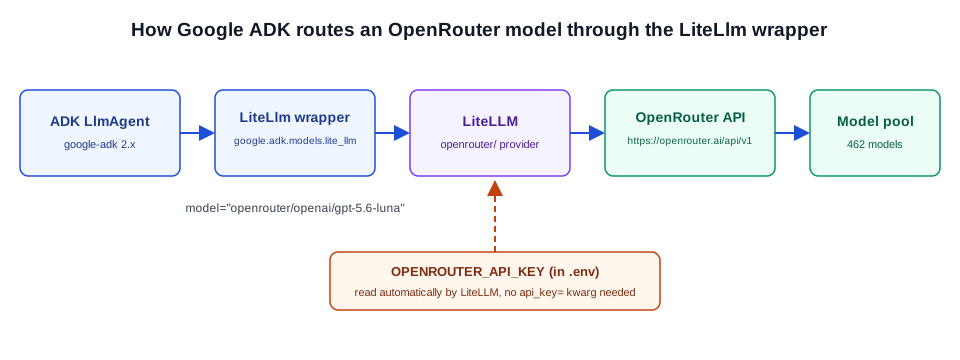
ADK’s model layer is dual-path, and the split is simple. Gemini and other Google models take a plain model string such as gemini-2.5-flash, handled by the google-genai client. Everything else goes through a wrapper class. LiteLlm is the wrapper for OpenAI-compatible providers, and OpenRouter is one of them.
from google.adk.models.lite_llm import LiteLlm

model = LiteLlm(model="openrouter/openai/gpt-5.6-luna")
The constructor passes its keyword arguments straight through to litellm.completion(). Whatever LiteLLM accepts, LiteLlm accepts. That is why the wrapper is thin and why the model string format is LiteLLM’s, not ADK’s: openrouter/<vendor>/<model>, where <vendor>/<model> is exactly the ID from OpenRouter’s models API. For openai/gpt-5.6-luna the full string is openrouter/openai/gpt-5.6-luna. Copy the ID from the API response, not from blog posts, and the prefix math takes care of itself.
Env-only config: drop api_key and api_base
LiteLLM reads OPENROUTER_API_KEY from the environment on its own and defaults the base URL to https://openrouter.ai/api/v1. Passing both as kwargs still works, it is just noise. I would keep the model string as the only argument and let the env do the rest.
Env-only (recommended)
from google.adk.agents import Agent
from google.adk.models.lite_llm import LiteLlm

root_agent = Agent(
    name="my_adk_agent_openrouter",
    model=LiteLlm(model="openrouter/openai/gpt-5.6-luna"),
    description="A helpful assistant using an OpenRouter model, with web search and memory.",
    instruction="Answer helpfully. Use tools when they are relevant.",
    tools=[adk_tavily_tool, remember_something],
)
Explicit kwargs (legacy)
import os

from google.adk.agents import Agent
from google.adk.models.lite_llm import LiteLlm

root_agent = Agent(
    name="my_adk_agent_openrouter",
    model=LiteLlm(
        model="openrouter/openai/gpt-5.6-luna",
        api_key=os.getenv("OPENROUTER_API_KEY"),
        api_base="https://openrouter.ai/api/v1",
    ),
    description="A helpful assistant using an OpenRouter model, with web search and memory.",
    instruction="Answer helpfully. Use tools when they are relevant.",
    tools=[adk_tavily_tool, remember_something],
)
One optional extra: OpenRouter attribution headers. LiteLLM exposes OR_SITE_URL and OR_APP_NAME as environment variables so your app can show up in OpenRouter’s rankings. Header names on OpenRouter’s side moved to HTTP-Referer and X-OpenRouter-*, so confirm the mapping in LiteLLM’s docs if attribution matters to you.
Use native Gemini strings for Gemini
Do not route Gemini through LiteLLM
Current ADK source warns when a Gemini model goes through LiteLlm (_warn_gemini_via_litellm). Use plain model strings like gemini-2.5-flash for Google models and reserve LiteLlm for everyone else. The 1.5 generation (gemini-1.5-flash-latest and friends) is retired; do not copy old tutorials that still reference it.
Streaming is handled for you. The LiteLlm class and the Runner manage the stream internally and strip any stream kwarg you pass, so do not build your call site around it.
Tool calling and Claude thinking blocks
LiteLLM forwards function calls for models that support them. That is what keeps the Tavily search tool and remember_something working after you swap the model. Two details worth knowing:
- Since ADK v1.28.0,
LiteLlmpreserves Anthropic thinking-block signatures across turns when you run Claude models. You get the multi-turn reasoning continuity without extra code. - ADK now repairs malformed tool-call JSON from flaky models (
_parse_tool_call_argumentsinlite_llm.py). It does not make a weak model strong. If your agent produces broken calls, pick a model with solid function-calling support instead of blaming ADK.
Tool calling is also why protocols like what is MCP (Model Context Protocol) matter as your agent grows: the model’s ability to emit well-formed calls is the bottleneck, not your tool code.
Switch your ADK agent to an OpenRouter model (step by step)
The walk-through below evolves the part-1 agent, with Tavily search and the remember_something tool, onto an OpenRouter model. Each step has a verify line. Use it.
Prerequisites
- Completed part-1 agent:
Agent,Runner,InMemorySessionService,adk_tavily_tool, andremember_somethingall working. If you do not have that yet, build your first ADK agent with Tavily search and memory first. uvinstalled for the package work. See Getting started with uv for Python projects if it is new to you.- A Python project with
google-adk2.x and a.envholdingTAVILY_API_KEY(andGOOGLE_API_KEYif other parts still use Gemini). - An OpenRouter account for the API key in the next step.
- Target versions:
google-adk2.x,litellm>=1.84. No downgrade shims, no custom forks.
1. Get an OpenRouter API key and update .env
Create a key at openrouter.ai/keys. It looks like sk-or-v1-.... Put it in the .env at your project root:
# New line
OPENROUTER_API_KEY="sk-or-v1-PASTE_YOUR_KEY_HERE"

# Keep what you still need
TAVILY_API_KEY="YOUR_TAVILY_API_KEY"
# GOOGLE_API_KEY="YOUR_GOOGLE_API_KEY"  # drop it if nothing uses Gemini anymore
Two cheap safety rails
Never commit .env. Check git status before your first commit and keep the file ignored. And set a hard credit limit on the key at creation time, not after the first surprise bill. You can always raise it later.
Verify:
curl -s https://openrouter.ai/api/v1/key \
  -H "Authorization: Bearer $OPENROUTER_API_KEY"
Healthy output is a JSON object with your key label and remaining credits. If you get 401, the key is wrong, missing, or not loaded into your shell.
2. Install LiteLLM with uv (pinned version)
uv add "litellm>=1.84"That constraint is deliberate. LiteLLM 1.82.7/1.82.8 were the compromised releases from the March 2026 incident, and the ADK docs now require >=1.84. Current latest is 1.105.1 as of October 2026. Commit uv.lock in the same change. If uv is still new to your workflow, Getting started with uv for Python projects covers project setup and lockfiles.
Verify:
uv tree | grep litellmYou want a version at or above 1.84. Anything lower, stop and re-run the add with the pin.
3. Update the agent code with LiteLlm
Drop-in replacement for the root_agent definition from part 1:
from google.adk.agents import Agent
from google.adk.models.lite_llm import LiteLlm

root_agent = Agent(
    name="my_adk_agent_openrouter",
    model=LiteLlm(
        model="openrouter/openai/gpt-5.6-luna",
        # No api_key/api_base needed: LiteLLM reads OPENROUTER_API_KEY from
        # the environment and defaults the base URL to
        # https://openrouter.ai/api/v1
    ),
    description="A helpful assistant using an OpenRouter model, with web search and memory.",
    instruction="""You are a friendly and helpful assistant.
1. For anything needing up-to-date info, use the 'TavilySearchResults' tool.
2. To remember something, use the 'remember_something' tool.
3. Use session state memories when relevant.
4. Otherwise answer directly.""",
    tools=[adk_tavily_tool, remember_something],
)
What changed and what did not:
- The
modelparameter is now aLiteLlminstance instead of a bare Gemini string like"gemini-2.5-flash". - The string inside is
openrouter/<vendor>/<model>. Vendor and model come straight from OpenRouter’s models API, soopenai/gpt-5.6-lunabecomesopenrouter/openai/gpt-5.6-luna. One prefix, no doubling. tools,instruction,Runner, andInMemorySessionServiceare untouched. That is the point of the wrapper.
Verify: a syntax-level check first.
uv run python -c "from agent_module.agent import root_agent; print(root_agent.model)"Adjust agent_module.agent to your actual module path. You want the LiteLlm object printed, not an ImportError.
4. Run the agent with adk web
adk webor run your script directly:
uv run python -m agent_module.agentVerify: the agent answers and a tool call fires. Ask “what’s the latest news about the EU AI Act?” and watch the dev UI or terminal. If you only get a text answer with no Tavily invocation, the model is not calling tools. See troubleshooting below.
adk api_server is unauthenticated
ADK 2.12’s CLI grew well past web/run: adk create, deploy, eval, eval_set, migrate, optimize, conformance, telemetry, test, and api_server. One caveat: adk api_server serves its endpoints without authentication. Bind it to localhost or put it behind your own proxy. Never expose it to the internet as-is.
Common run failures: port 8000 already in use means a stale adk web is still running, kill it and retry. Missing keys usually mean you started the command outside the project root and the .env never loaded.
Rollback
Undo is one line: set model="gemini-2.5-flash" (a native Gemini string) and the agent is back on Google’s infra. Nothing else in the codebase changed during the swap. If you want the dependency gone too, uv remove litellm.
Verify the OpenRouter model works before you celebrate
Model IDs churn weekly. Typos and retired IDs return 404, and it is much faster to catch that in curl than inside ADK’s stack trace. Run these four checks in order.
1. Key is valid and you can see credits:
curl -s https://openrouter.ai/api/v1/key \
  -H "Authorization: Bearer $OPENROUTER_API_KEY"
2. The model ID exists:
curl -s https://openrouter.ai/api/v1/models | jq -r '.data[].id' | grep gpt-5.6-lunaEmpty output means the ID is wrong or the model is gone. Pick another from the full list.
3. One cheap end-to-end completion:
curl -s https://openrouter.ai/api/v1/chat/completions \
  -H "Authorization: Bearer $OPENROUTER_API_KEY" \
  -H "Content-Type: application/json" \
  -d '{"model":"openai/gpt-5.6-luna","messages":[{"role":"user","content":"say ok"}],"max_tokens":10}'
You want a short completion back. 401 is auth, 404 is model ID, 429 is rate limit or no credits.
4. Tool-call smoke test through adk web: ask a question that forces Tavily and confirm the tool invocation appears, not just the answer.
- Key check returns label and credits
- Model ID found in
/api/v1/models - Cheap
/chat/completionscall returns a completion adk webfires a real tool call
Picking an OpenRouter model: pricing and tool support
Prices below were pulled from the OpenRouter API in October 2026. They move, sometimes weekly. Re-check before you budget around them.
| Model (OpenRouter ID) | Context | Input $/1M | Output $/1M | Tools |
|---|---|---|---|---|
openai/gpt-5.6-luna |
1.05M | $0.20 | $1.20 | yes |
deepseek/deepseek-v4.1-flash |
1.05M | $0.02 | $0.72 | yes |
z-ai/glm-5.3 |
1.05M | $0.10 | $4.80 | yes |
google/gemini-3.8-flash |
1.05M | $0.75 | $3.75 | yes |
x-ai/grok-4.7 |
500k | $2.00 | $6.00 | yes |
anthropic/claude-sonnet-5.5 |
1M | $2.00 | $10.00 | yes |
moonshotai/kimi-k3 |
1.05M | $0.45 | $16.50 | yes |
Notes on the table: z-ai/glm-5.3 is available through OpenRouter, or direct from GLM 5.3 from Z.ai if you would rather skip the gateway. For the moonshotai/kimi-k3 row, the older Kimi K2 in 2026 and what to use now covers how that family evolved. And if sub-$1/M-token pricing is the whole game for you, the cheapest AI models under $1 per million tokens list goes deeper than one table.
Before committing an agent to a model, check function-calling support explicitly:
curl -s https://openrouter.ai/api/v1/models \
  | jq '.data[] | select(.id=="openai/gpt-5.6-luna") | .supported_parameters'
The output must contain tools. A model without it will answer questions and silently ignore your functions, which looks like an ADK bug and is not one.
Do not hardcode preview or stealth model IDs
The first version of this article used quasar-alpha as the demo model. It was a cloaked preview model, later widely reported as a GPT-4.1 family test, and OpenRouter retired it. Today openrouter/quasar-alpha returns {"error":{"message":"Not Found","code":404}}. Preview IDs vanish. Resolve every model ID against https://openrouter.ai/api/v1/models and treat anything labeled preview, stealth, or free-preview as temporary.
For open-weight options that hold up in agent workloads, see the best open source LLM alternatives to Claude and GPT.
Browse the OpenRouter model listTroubleshooting Google ADK OpenRouter errors
| Symptom | Cause | Fix |
|---|---|---|
404 Not Found from OpenRouter |
Model ID typo, or a retired/preview model | List IDs with curl -s https://openrouter.ai/api/v1/models | jq -r '.data[].id' and copy from there |
401 Unauthorized |
Missing or wrong key, .env not loaded, key not sk-or- |
Run from project root, echo $OPENROUTER_API_KEY, re-create the key if needed |
| Agent answers but never calls tools | Model does not support function calling | Check supported_parameters contains tools, switch models |
UnicodeDecodeError on Windows with LiteLLM |
Python locale encoding on cp1252 | Set PYTHONUTF8=1 before launching (the fix ADK documents) |
Rate limits or garbage answers on :free models |
Free tier throttles hard and quality varies | Move to the paid variant of the same model |
| Malformed tool-call JSON in logs | Flaky open model emitting bad calls | ADK repairs what it can; a stronger model is the real fix |
adk web fails to start or serves stale code |
Old process on the port, wrong working directory | Kill stale adk web processes and re-run from the project root |
Can I use free OpenRouter models with ADK?
Yes, for exploration. Append :free to the model ID and accept rate limits and unreliable tool calling. Fine for testing the wiring, bad for an agent you depend on. Verify tool calls fire before building on a free variant.
Why does my ADK agent return 404 on OpenRouter?
Almost always a model ID problem. Either a typo, or a preview/stealth model that got retired. This is what happened to quasar-alpha. Pull the live ID list from https://openrouter.ai/api/v1/models and compare. An auth failure looks different (401), so the status code already narrows it down.
Do I still need GOOGLE_API_KEY?
Only if something in the project still calls Google models. If you dropped native Gemini model strings entirely, the key is dead weight and you can remove it from .env. Keep it while any agent or tool still uses Gemini, including Gemini models routed through Vertex.
Which OpenRouter models support tool calling?
Check supported_parameters on each model in the /api/v1/models response. If tools is listed, function calling is supported. Most of the mainstream chat models in the pricing table above do. Test with one real tool call anyway, advertised support and reliable calls are different things.
Is LiteLLM 1.82 safe to use?
No. Versions 1.82.7 and 1.82.8 on PyPI contained unauthorized code found in March 2026. Pin litellm>=1.84, rotate any secrets that were on a machine which installed the bad versions, and keep your lockfile committed.
Cost control and model failover
Set a hard credit limit on each OpenRouter key when you create it. The activity dashboard and the /api/v1/key endpoint show spend, and both take seconds to check. For async work, :batch variants discount the same models when latency is irrelevant.
Cost order of magnitude: a light personal agent on deepseek/deepseek-v4.1-flash lands in the cents-to-a-few-dollars per month range at hobby usage. A heavy anthropic/claude-sonnet-5.5 workflow is the one to put a limit on, because $10/1M output tokens adds up fast when an agent loops on tool calls.
In Python today, failover is LiteLLM’s job, not ADK’s. Pass fallbacks to the completion call and you get a defined primary-to-secondary chain instead of a dead agent when the first model 429s:
from litellm import completion

resp = completion(
    model="openrouter/openai/gpt-5.6-luna",
    messages=[{"role": "user", "content": "say ok"}],
    fallbacks=[
        {"model": "openrouter/deepseek/deepseek-v4.1-flash"},
        {"model": "openrouter/anthropic/claude-sonnet-5.5"},
    ],
)
ADK’s own answer to per-request routing is RoutedLlm/RoutedAgent, which picks a model and fails over on error. That is TypeScript-only and experimental right now, so in Python the LiteLLM router and fallbacks are the boring reliable default.
If you also live in Claude Code, Codex, or Gemini CLI, Agent Router for multi-model routing gives you the same any-model pattern for coding agents.
Conclusion
The swap is one line: LiteLlm(model="openrouter/<vendor>/<model>"). Keep the pin (litellm>=1.84), keep your lockfile, and run the four verify checks before trusting any model ID that is new to you. Tools and session memory never change, which is what makes model churn cheap.
Next in the series: the ADK multi-agent research team with Tavily and Crawl4AI, where several agents split research work instead of one doing everything.
Build the ADK Multi-Agent Research TeamThe same any-model idea shows up elsewhere: how to plug any model into the Codex app covers it for coding tools. And if you want a different Python agent framework to compare against ADK, getting started with Agno agents is a good side trip.