How to Choose a Good Domain Name
Practical tips for picking a domain name that's easy to remember, good for SEO, and available -- plus a tool that does most of the work for you.

3 min read
Your domain name is what people see when they look you up and what they type when they come back. Pick a bad one and you lose traffic, trust, and sometimes real money when you have to rebrand later.
Here’s how to choose one that holds up.
Tip 1: Research before you brainstorm
Know what your site is actually about before picking a name. Who’s the audience? What problem does the site solve? What keywords show up in that space?
Tools like Google Trends and AnswerThePublic show what people are searching for. NameMesh, DomainWheel, and AI-based generators like brandsnap.ai (covered below) can turn keywords into name ideas.
If you want to create a travel site, you might explore: TravelHub, WanderList, TripTrace. Short combos like these are a better starting point than stuffed-keyword names.
Tip 2: Keep it short and simple
The practical limits:
- Under 15 characters if possible
- No hyphens, numbers, or symbols (4travel.com and trip-advisor.net both fail this)
- Easy to spell when heard out loud — if you have to spell it out for people, it’s too complex
- No slang, abbreviations, or inside-industry acronyms
Tip 3: Use keywords, but don’t stuff them
A domain with a relevant keyword in it can help with SEO, but exact-match domains (cheapflights.com, besttraveldeals.com) no longer get a ranking boost the way they did years ago. Google cares more about content quality and user experience.
What works better are partial-match or branded domains:
- Partial-match: travelocity.com, expedia.com — one keyword, rest is brand
- Branded: airbnb.com, trivago.com — no keyword, but memorable and unique
Both types can rank well if the content backs them up.
Tip 4: Check availability and trademarks before you fall in love with a name
Use Whois to check if the domain is registered. If it’s taken, check whether the current registrant is using it or just squatting — sometimes you can buy parked domains for a reasonable price.
Also check trademarks at USPTO or Trademarkia. Using a trademarked name in your domain can get you into legal trouble even if the domain itself was available to register.
Use brandsnap.ai to find available names fast
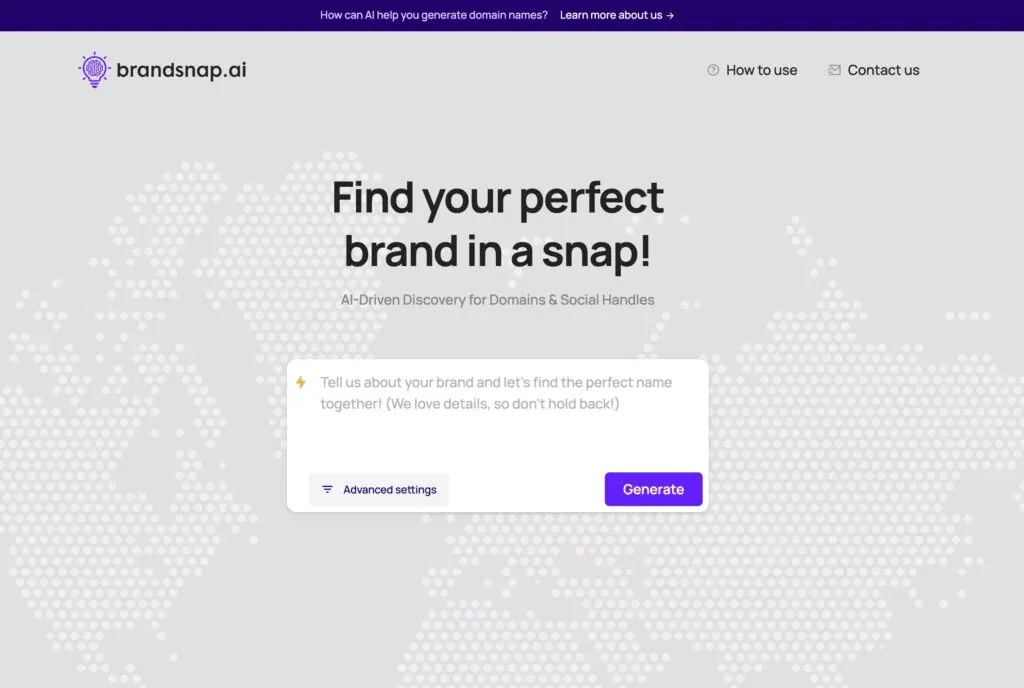
brandsnap.ai is an AI-powered tool that generates domain name ideas and checks availability across .com, .io, .ai, .org, and .net at the same time. You pick a style (casual, formal, business, playful), enter your topic, and it returns a list with trademark status and registrar links.
It cuts the back-and-forth of checking names one by one. Useful when you know your niche but haven’t settled on a name yet.
What extension to use
There are now over 1,500 TLDs available, but .com is still what people type when they’re guessing. It’s the most trusted extension and the one buyers will pay the most for on resale.
If .com isn’t available:
.ioworks well for tech and SaaS products.aihas become popular for AI-related projects and startups (prices range from $20-80/year depending on registrar).cois common and recognizable.tech,.dev,.appare accepted in developer/startup circles.storeand.shopwork for e-commerce- Country-code domains (
.ca,.de,.co.uk) are fine if the audience is local and can help with local SEO
Avoid obscure TLDs unless there’s a specific reason. .info, .biz, and .name don’t carry much trust. Some lesser-known TLDs also end up on email blocklists, which can hurt deliverability if you use the domain for email.
A note on domain length
Data from Wix’s 2026 domain statistics report shows the average domain length is 11-13 characters. Shorter is better for recall, but don’t sacrifice clarity for brevity. A 14-character name that makes sense beats a 6-character name nobody can remember.